Website
Should Your UAE Website Be Bilingual? An English–Arabic Guide for UAE Businesses
"Do we need an Arabic version?" It's a question almost every new UAE client asks us — and the honest answer is less clear-cut than most business owners expect.
Arabic is the official language of the UAE, yet a great deal of day-to-day business here happens in English. That means a bilingual website is not an automatic yes or no — it's a commercial decision that depends entirely on who actually buys from you.
Across 40+ website launches we've seen it go both ways: businesses where adding Arabic made a genuine difference, and businesses that spent budget on an Arabic version almost nobody visited. Here's how to make the call properly — and what doing it well actually involves. If you decide to go ahead, our website development team in the UAE builds bilingual English–Arabic sites with a built-in toggle and full right-to-left support.
1.Start with who actually buys from you, not with demographics
It's easy to look at UAE demographics and conclude that you need Arabic. But general demographics are not your customer base. A company selling software to startups in Dubai Internet City operates in an almost entirely English environment. A company bidding for government or semi-government work, or serving Emirati families, is in a completely different position.
The fix: Look at your actual customer data before deciding. Check the language of your inbound enquiries, who you win contracts from, and the language data in Google Analytics for your current site. If you haven't had a single Arabic enquiry in a year, that's useful information. If you regularly bid for public-sector work, that's equally useful information — in the opposite direction.
2."Bilingual" means three quite different things
When business owners ask for a bilingual website, they usually mean one of three quite different things — and the cost and effort vary enormously between them: a language toggle inside the same site, a separate Arabic site on its own subdomain, or simply bolting on a machine-translation widget.
The fix: For most UAE SMEs, a toggle within the same site is the right choice: lower cost, one set of content to maintain, and a seamless experience for the visitor. Separate sites suit larger organisations that need genuinely different content for each audience — and in practice mean two sites to maintain forever. Machine-translation widgets look like a cheap shortcut, but they're the one option that can actively work against you.
3.Right-to-left is not a checkbox
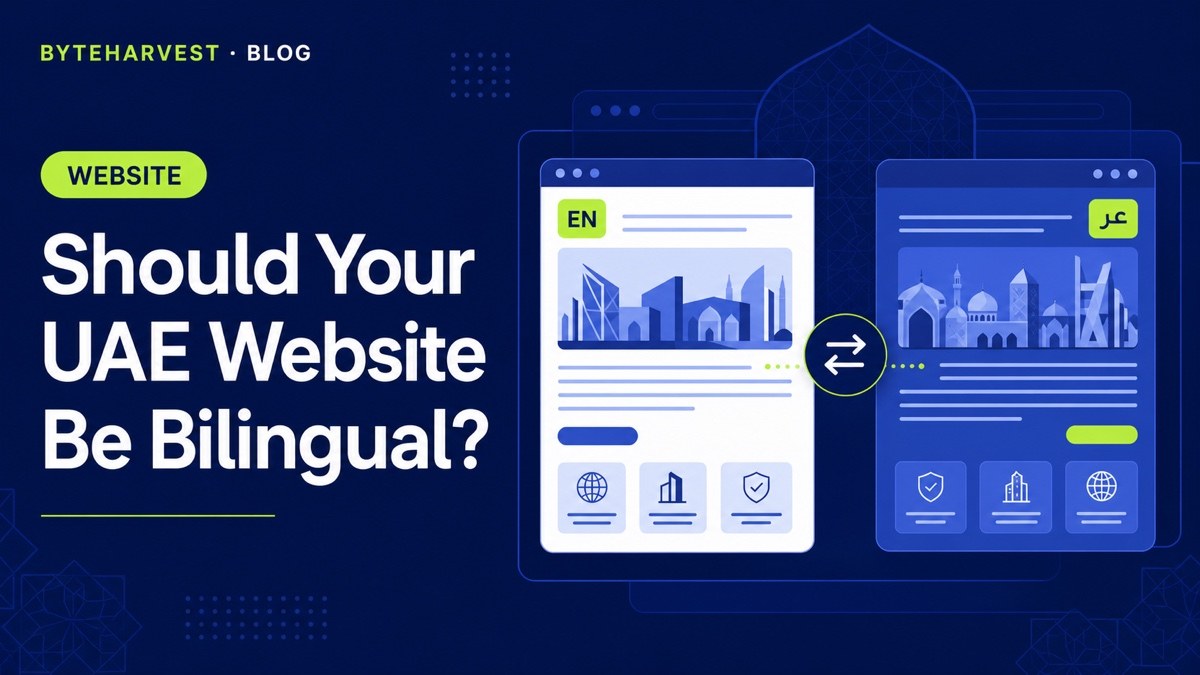
This is the part that gets underestimated most. Arabic reads right to left, and that doesn't just mean flipping the text — it means mirroring the entire layout. Navigation, columns, icons, arrows, form fields, button alignment, even scroll direction: all of it reverses. A site that drops Arabic text into a layout designed for English looks broken to an Arabic reader, even when every single word is translated correctly.
The fix: Ask your developer to show you the Arabic version on a real phone before launch, not a desktop screenshot. Check forms specifically — input fields and error validation are what break most often in RTL. If the site is built with RTL in mind from the start, it's straightforward; retrofitting it onto a design that never planned for it is where costs balloon.
4.Machine translation will cost you more than it saves
Machine translation handles grammar reasonably well, but it consistently fails on three things that matter commercially: tone, specialist terminology, and the formal register expected in Arabic business communication. The result is Arabic that is technically comprehensible but immediately reads as unprofessional — to precisely the audience you added it for.
The fix: Budget for a human translator for at least your core pages — homepage, service pages, and contact. A handful of professionally translated pages beats an entire machine-translated site. If the budget doesn't stretch to human translation, the better decision is to postpone the Arabic version rather than launch one that undermines your credibility. Credibility is a conversion signal before it is a language question — and it's one of the seven reasons a UAE website doesn't convert.
5.An Arabic site is not Arabic SEO
This is the point we correct most often. Translating your site makes it usable for Arabic speakers who have already found you. It does not make you appear in Arabic search results. Ranking in Arabic search is an entirely separate discipline: Arabic keyword research, an Arabic content strategy, and correct hreflang implementation so Google serves the right language version. That is different work from building a translated site. Overlooking Arabic search is the third entry in our list of 10 SEO mistakes UAE businesses make — and the one most often confused with translation.
The fix: Treat a bilingual site as a user-experience and credibility decision, not an SEO shortcut. We build bilingual English–Arabic websites; our SEO campaigns are delivered in English. If Arabic search is central to your growth plan, we'll tell you that upfront rather than overpromise.
6.The real cost is maintenance, not the build
The upfront cost of adding Arabic is usually reasonable when it's planned from the start. The cost that catches businesses out is what comes afterwards: every new blog post, every service page, every price update, every promotion now needs an Arabic version too. Bilingual sites that fail rarely fail at launch — they decay gradually, as English content piles up and the Arabic side goes stale.
The fix: Be honest about what you can sustain before you start. If you don't have a clear process for translating new content, limit the Arabic version to stable pages that rarely change — home, services, about, and contact — and leave the blog in English. A smaller Arabic site that stays current always beats a full one that's two years out of date.
Making the call
If you want a simple working rule, it's this: add Arabic when your customers expect it, not when it merely feels appropriate. Sequence the decision like this — first, check your actual customer data; if there's no clear signal, don't add Arabic yet. Second, if the signal is there, start with core pages only, human-translated, and properly planned for right-to-left. Third, put a process in place to keep those pages current before you expand. And fourth, if your goal is specifically to appear in Arabic search results, understand that this is a separate project requiring dedicated Arabic expertise — far better to know that upfront than to discover it six months in.
Key takeaways
- Start with your actual customer data, not general UAE demographics.
- A toggle within one site is the right fit for most UAE SMEs.
- Right-to-left means mirroring the whole layout, not just the text.
- Avoid machine translation — a few human-translated pages beat a full automated site.
- A translated site does not make you rank in Arabic search; that's a separate discipline.
- Maintenance is the real cost — don't build more Arabic than you can keep current.
Not sure whether Arabic is right for your site?
Book a free 30-minute strategy call and we'll review your actual audience and tell you honestly whether a bilingual site is worth the investment in your case.
Book a Free Strategy Call →Bilingual English–Arabic sites are part of our website development service in the UAE. See real examples like Greenoz Solutions and GKCA Global in our work.