Industries
What Makes UAE Patients Choose One Clinic Over Another Online (And How to Win That Decision)
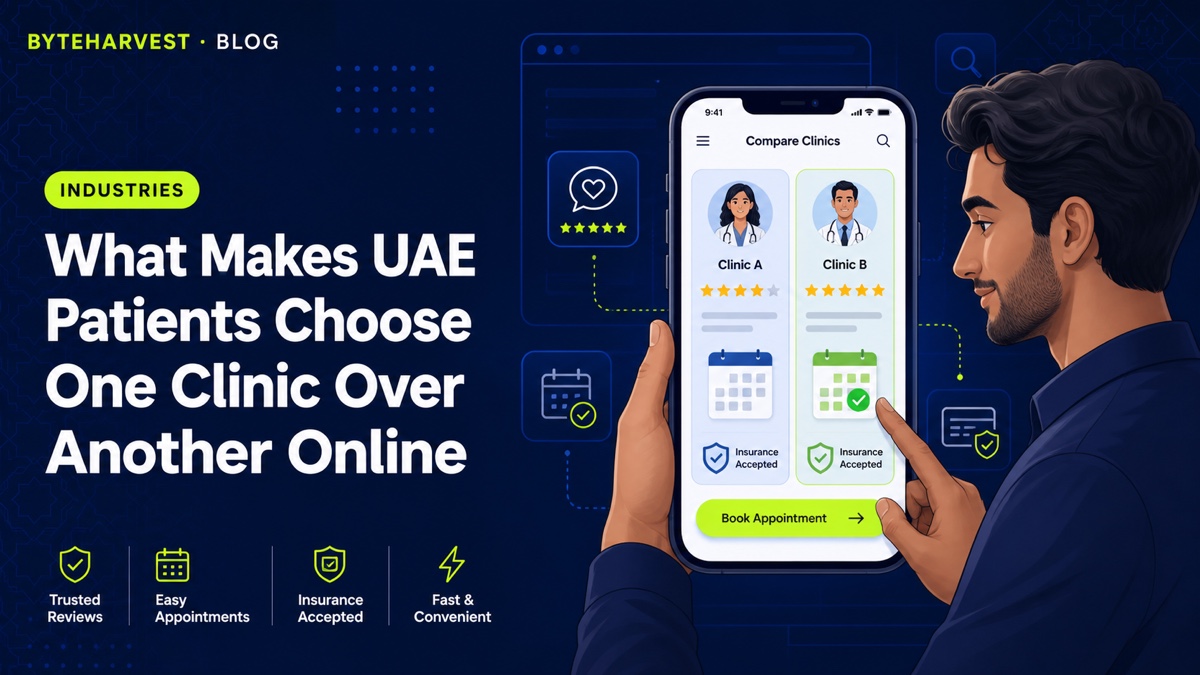
A patient rarely calls the first clinic they find. They open four or five tabs, give each one about a minute, and quietly eliminate most of them before your reception phone ever rings.
Every month we audit clinic websites across the UAE — dental practices, paediatric clinics, women's health centres, specialist consultants — and the pattern is remarkably consistent. The clinics losing patients online are almost never the weaker clinics medically. They are the ones whose website fails a short series of trust checks that patients run without ever consciously thinking about them.
Healthcare is the one sector where the decision is made almost entirely before contact. In retail a customer can browse and come back later; in healthcare, a patient who doesn't feel reassured in the first minute simply moves to the next listing and never returns. Below are the seven checks UAE patients run, roughly in the order they run them, and what it takes to pass each one. They come out of the clinic projects we deliver through our healthcare and clinic marketing work across the Emirates.
1.Your homepage doesn't say what you treat, or where you are, in the first five seconds
Most clinic homepages open with a stock photo, a welcome message, and a mission statement. None of that answers the two questions the patient actually arrived with: do you treat my problem, and are you near me? A parent searching at 11pm for a paediatrician who can see their child tomorrow is not reading your philosophy of care.
The fix: Put the specialisation and the location in the first heading a visitor sees — not in the third section down. "Paediatric and family clinic in Al Barsha, Dubai" does more work than any welcome paragraph. Directly beneath it, list your main treatment areas as links, so a patient can confirm within seconds that you handle what they came for. Save the mission statement for the About page, where the small number of people who want it will find it.
2.Your doctors are names on a list, not people with credentials
This is the single biggest trust gap we see on UAE clinic sites. A patient is deciding whether to let a stranger treat them or their child, and the website offers a name, a title, and nothing else. Where did this doctor train? How many years have they practised? Which languages do they speak? In a market where patients come from dozens of countries, that last question matters far more than most clinics realise.
The fix: Give every practitioner a real profile page with a proper photograph, qualifications, years of experience, their DHA, DoH or MOH licence status, sub-specialities, and the languages they consult in. Photographs should be consistent and taken in the clinic where possible — a mismatched set of headshots pulled from different sources reads as improvised. If a doctor has published, presented, or trained abroad, say so plainly. These pages also tend to become some of the highest-traffic pages on a clinic site, because patients search doctors by name after a recommendation.
3.Your reviews are invisible on your own website
Patients check reviews. What most clinics miss is that they check them twice — once on Google before clicking through, and again on the website, looking for the clinic's own confidence in what patients say about it. A site with no testimonials anywhere reads as a clinic that would rather you didn't look.
The fix: Pull genuine patient reviews onto the site, ideally close to the booking call-to-action where they do the most work, and refresh them so they don't sit unchanged for two years. Just as important is what happens on Google itself: a steady, recent stream of reviews and a clinic that replies to them — including the critical ones, briefly and professionally — outperforms a higher star rating with no responses. Review generation and Google Business Profile management are part of what our SEO campaigns handle for healthcare clients, because in this sector reviews are not a vanity metric, they are the ranking and the referral.
4.Booking still means calling during working hours
A large share of clinic research happens in the evening, at weekends, and on public holidays — precisely when nobody is at your reception desk. If the only way to act on that interest is a phone number, you are asking a motivated patient to hold the intent overnight. Most of them will not; they will book with whichever nearby clinic let them do it there and then.
The fix: Give patients a way to request an appointment at the moment they decide, whether that is a full booking integration with your practice management system or a simple enquiry form that reaches your team's WhatsApp. The form should be short — name, contact, preferred time, reason for visit — because every extra field costs you completions. Then commit internally to a response time and hold to it: a booking request answered the next morning is worth far more than one answered in three days. We build these flows as standard in our website development projects for clinics.
5.You rank for your clinic's name, but not for the symptom
Almost every clinic ranks first for its own name. That traffic is people who already know you — existing patients and referrals. It is not growth. Growth is the patient who has a problem and no clinic in mind, searching for the symptom, the treatment, or "near me" — and those are exactly the searches most clinic websites have no page for.
The fix: Build a page for each treatment and condition you actually want to be found for, written the way patients describe the problem rather than the way it appears in a medical directory. Someone searching for "tooth pain when biting" is not searching for "endodontic assessment". Cover what the condition is, what treatment involves, what it costs, and what happens at the first visit. Alongside that, keep the local signals in order — an accurate, complete Google Business Profile with correct hours and location, and a separate page per branch if you have more than one, so a patient searching in Sharjah reaches your Sharjah location rather than a general contact page.
6.The site is slow on the one device every patient uses
Clinic websites are heavy: image galleries, before-and-after sets, doctor photographs, booking widgets, chat plugins. On a laptop over office broadband, none of that shows. On a phone on mobile data — which is where most of this research actually happens — a site that takes six seconds to become usable has already lost a meaningful share of the people who reached it.
The fix: Test your own site on a phone, on mobile data, away from the clinic's WiFi, and time how long it takes before you can tap something useful. Compress and correctly size every image, remove the third-party scripts nobody has looked at in a year, and make sure the phone number and booking button are reachable without scrolling. Then check the small things that break on mobile specifically: tap targets too close together, forms that zoom the page when you select a field, and maps that trap the scroll. None of this is clinic-specific: the same faults show up in the seven reasons a UAE website doesn't convert, whatever your sector.
7.Nothing on the site answers the insurance question
In the UAE this is often the last check before a patient calls, and it is the one most clinic websites ignore completely. Patients want to know which insurance networks you accept, whether their plan covers the consultation, what the fee is if it doesn't, and whether they need a referral. When a site is silent on all of it, the patient either calls to ask — adding friction you didn't need — or picks the clinic that answered the question in writing.
The fix: Publish a clear list of the insurance providers and networks you work with, keep it current, and state plainly what a self-paying consultation costs. Add a short "your first visit" section covering what to bring, how long the appointment takes, and where to park. None of this is glamorous content, and it consistently removes more hesitation than anything else on a clinic website. If you also serve a substantially Arabic-speaking patient base, this is the content to translate first — see our guide on whether your UAE website should be bilingual for how to make that call properly.
Where to start
Seven fixes is a lot to take on at once, and they are not equally urgent. If you do them in the order they appear above, you will be working roughly in order of impact per effort — but the practical sequence for most clinics is this. First, fix what a patient sees in the opening seconds: the homepage heading, and the doctor profiles. That is copy and photography, it costs little, and it changes the impression of the clinic immediately. Second, remove the friction: an enquiry or booking route that works out of hours, and honest insurance and pricing information. Both convert interest you are already generating, so they pay back fastest. Third, and only once the site converts properly, invest in visibility — treatment pages, local SEO, and review generation. Sending more patients to a site that loses them is an expensive way to discover that the site loses them.
Key takeaways
- Patients decide between clinics on the website, before anyone calls you.
- Say what you treat and where you are in the first heading, not the third section.
- Doctor profiles with credentials, licence status and languages are the biggest trust gap on UAE clinic sites.
- Reviews are checked twice — on Google, then on your own site. Reply to them.
- Out-of-hours enquiry routes capture the evening and weekend research where most clinic decisions start.
- Ranking for your clinic's name is not growth; ranking for the symptom is.
- Insurance and pricing clarity removes more hesitation than any other content on a clinic website.
Want to know why your clinic's website isn't converting enquiries?
Book a free 30-minute strategy call. We'll walk through your site the way a patient would and tell you exactly where enquiries are being lost — no strings attached, just honest advice.
Book a Free Strategy Call →Clinic websites, healthcare SEO, and patient booking flows are part of our healthcare and clinic marketing service in the UAE. See it in action with Kids Growth Clinic, Birthnest Women's Clinic, and Othisis MedTech in our work.